
AI supervisor assist live monitoring enables supervisors to track active customer conversations as they happen, with artificial intelligence analyzing speech patterns, sentiment, and compliance triggers to recommend coaching actions instantly. Instead of reviewing recorded calls hours or days later, supervisors receive alerts and suggested responses during the conversation when guidance can still change the outcome. This technology analyzes every call across your team simultaneously, something impossible with traditional manual monitoring.
Why Traditional Call Monitoring Falls Short
Most contact centers still rely on supervisors randomly selecting a handful of recorded calls each week for review. This approach samples less than 5% of total conversations and delivers feedback long after the customer interaction ends. Agents receive coaching about mistakes made days earlier, with no opportunity to correct course during the original call. Pattern recognition depends entirely on supervisor availability and memory, making it nearly impossible to spot emerging trends or compliance risks across hundreds of daily calls.
Manual monitoring also creates uneven coaching quality. Different supervisors prioritize different aspects of call performance, leading to inconsistent feedback across team members. High-performing agents often receive less attention than struggling ones, missing opportunities to reinforce best practices or identify scalable techniques.
How Live Call Analysis Changes Supervisor Workflows
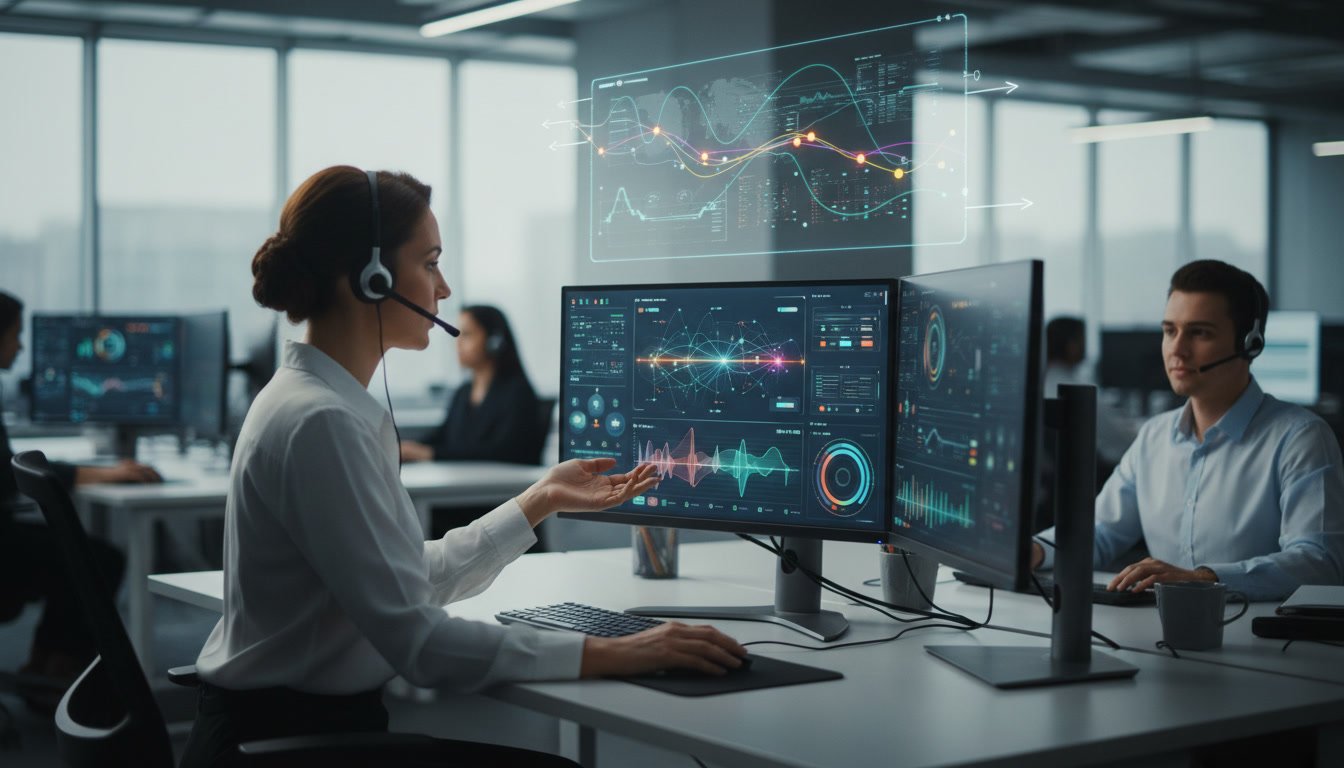
AI-powered systems listen to every conversation in your queue simultaneously, transcribing speech to text and running real-time analysis on tone, keywords, compliance phrases, competitor mentions, and customer sentiment shifts. When the system detects a coaching moment, such as a customer expressing frustration or an agent skipping a required disclosure, it surfaces an alert to the supervisor dashboard with context and suggested actions.
Supervisors can monitor multiple calls at once through a unified interface that highlights conversations requiring immediate attention. Color-coded indicators show sentiment trends, script adherence, and talk-time ratios without requiring supervisors to listen to every second of audio. This selective attention model allows a single supervisor to effectively oversee 20 or more simultaneous calls, intervening only when AI flags a high-priority event.
Real-Time Coaching Prompts Agents Actually Receive
The agent experience differs from traditional call barging or whisper coaching. Instead of supervisor audio interruptions, agents receive discrete visual prompts on their screen during the conversation. These notifications might suggest a knowledge base article, remind the agent of a compliance requirement, or recommend a specific response based on customer objection patterns the AI recognizes.
For example, when a customer mentions a competitor product, the system can instantly surface a comparison sheet or recommended talking points. If a customer’s tone shifts negative, the agent receives a prompt to acknowledge frustration and offer escalation options. These suggestions arrive within two to three seconds of the triggering event, fast enough to influence the current conversation rather than the next one.
This approach supports agents without undermining their autonomy. They retain control over whether to use suggested responses, but gain access to institutional knowledge and supervisor expertise exactly when needed. AI Agent and Supervisor Assist tools integrate seamlessly with existing workflows, requiring minimal training for most teams.
What the AI Actually Monitors During Calls
Modern systems track dozens of conversation elements simultaneously. Sentiment analysis measures emotional tone in both customer and agent speech, flagging sharp negative shifts that often precede escalations or cancellations. Keyword detection identifies product names, competitor references, pricing discussions, and compliance-sensitive topics like payment processing or data security.
Talk ratios reveal whether agents dominate the conversation or allow customers sufficient time to explain concerns. Silence detection identifies awkward pauses that might indicate agent uncertainty or system delays. Script adherence tracking confirms agents deliver required disclosures, security verifications, and brand messaging at appropriate conversation stages.
The system also monitors call flow against ideal conversation structures learned from top-performing agents. If a sales call reaches the four-minute mark without transitioning to needs discovery, the AI might prompt the agent to ask qualifying questions. If a support call involves multiple holds totaling more than 90 seconds, it flags the interaction for quality review even if resolved successfully.
How Supervisors Prioritize Which Calls Need Attention in Greensboro and Beyond
With AI analyzing every conversation, supervisors need filtering tools to focus on highest-impact interventions. Dashboard interfaces typically offer multiple prioritization views. A risk-based view surfaces calls with compliance triggers, profanity, or extreme negative sentiment first. A coaching view highlights conversations where agents struggle with common objections or deviate significantly from proven talk tracks.
Opportunity views identify calls with high revenue potential, such as customers asking about premium features or expressing dissatisfaction with competitor services. Supervisors in markets like Greensboro can customize thresholds based on local customer expectations and regional compliance requirements. The system learns which alert types each supervisor acts on most frequently, gradually personalizing the priority queue to match individual management styles.
Some platforms allow supervisors to set custom triggers. A manager noticing increased churn in a specific customer segment might create a rule flagging any call where that customer type mentions cancellation-related keywords, enabling proactive retention efforts before the decision finalizes.

Integration with Quality Management and Performance Systems
Live monitoring data feeds directly into broader AI Quality Management systems, creating a continuous improvement loop. Coaching moments identified during live calls automatically generate tagged recordings and transcripts for later review sessions. Supervisors can quickly compile examples of specific behaviors, both positive and negative, without manually searching through call archives.
Performance metrics update in real time rather than weekly or monthly cycles. Agents see immediate score changes reflecting current call performance, making the connection between behavior and evaluation much clearer. This transparency helps newer team members understand quality standards faster than traditional delayed-feedback models.
The same AI models analyzing live calls can identify training gaps across the entire team. If 60% of agents struggle with a particular objection type, supervisors receive aggregated insights suggesting targeted coaching sessions or updated scripts rather than individual corrective actions. Many contact centers using these systems report reducing onboarding time by 30% or more, as new hires receive consistent, immediate guidance rather than waiting for scheduled supervisor check-ins.
Common Implementation Steps for Call Centers and Sales Teams
Deploying live monitoring typically follows a phased approach. The first step involves integrating the AI platform with your existing Business Phone System to access call audio streams. Cloud-based systems usually require only API authentication, while on-premises environments might need local recording server connections.
Next, teams configure baseline monitoring rules, starting with industry-standard compliance triggers and sentiment thresholds before adding custom business logic. Most organizations begin with supervisor-only alerts, allowing management to validate AI accuracy and adjust sensitivity settings before enabling agent-facing prompts.
A pilot phase with a small team subset helps identify workflow adjustments. Supervisors learn which alert types provide actionable intelligence versus noise, and agents provide feedback on prompt timing and relevance. This testing period typically lasts two to four weeks before full deployment.
Training focuses on interpreting AI insights rather than technical operation. Supervisors learn to distinguish between high-confidence alerts requiring immediate action and lower-confidence flags worth monitoring but not interrupting. Agents practice using suggested responses naturally rather than reading them verbatim, maintaining conversation authenticity.
Privacy, Compliance, and Recording Consent Considerations
Live call analysis raises important legal and ethical questions. In two-party consent states, businesses must inform customers that calls are monitored and analyzed, often through automated disclosures at call start. AI transcription and analysis typically fall under the same consent framework as traditional recording, but legal review ensures your specific implementation complies with state and federal regulations.
Data retention policies should specify how long transcripts and AI-generated insights remain accessible, balancing quality improvement needs against privacy principles. Many organizations treat AI analysis metadata separately from call recordings, purging detailed transcripts after 90 days while retaining aggregated performance metrics indefinitely.
Agent privacy deserves consideration as well. Constant monitoring can feel intrusive if not implemented thoughtfully. Clear policies about how AI data influences performance reviews, what triggers formal coaching versus informal suggestions, and how agents can contest AI-flagged issues help maintain trust. The most successful deployments position the technology as a support tool rather than a surveillance system.
Measuring ROI and Performance Improvements
Organizations typically track several metrics to evaluate live monitoring impact. First-call resolution rates often improve 15-25% as agents receive immediate guidance for complex issues rather than placing customers on hold or scheduling callbacks. Average handle time may initially increase as agents adapt to new prompts, then decrease as they internalize coaching patterns.
Compliance violation rates usually drop sharply, sometimes by 70% or more, as required disclosures and procedures receive automated enforcement rather than relying solely on agent memory. Customer satisfaction scores tend to rise gradually over three to six months as coaching quality improves and best practices spread across the team.
Supervisor productivity gains prove significant. Managers overseeing 10-12 agents with traditional monitoring can often handle 18-20 with AI assistance, as the system handles routine quality checks and surfaces only exceptional situations requiring human judgment. This efficiency allows smaller teams to maintain quality standards that previously required dedicated quality assurance staff.
Revenue impact varies by industry but commonly appears in reduced churn, higher upsell conversion rates, and faster new-hire productivity. One Small Business services provider reported a 22% increase in add-on sales within four months of deployment, attributing the gain to AI prompts that reminded agents to mention relevant products when customers expressed specific needs.
Why Real-Time Coaching Outperforms Delayed Feedback
Behavioral science research consistently shows immediate feedback produces faster skill development than delayed correction. When agents receive coaching during a call, they can apply the suggestion instantly and observe results, creating a direct cause-effect learning loop. This experiential learning embeds skills more deeply than reviewing past mistakes in abstract coaching sessions.
Immediate intervention also prevents small issues from escalating. A customer expressing mild frustration at the two-minute mark might become an angry escalation by minute six if the agent misses early warning signs. AI alerts give agents a chance to course-correct before negative sentiment hardens, often salvaging interactions that would otherwise end poorly.
The technology creates consistency impossible with human-only supervision. Every agent receives the same quality of monitoring regardless of shift timing or supervisor workload. Night shift teams and remote workers get equal attention to day shift staff, eliminating the performance gaps that often emerge when supervision quality varies.
Building a Smarter, More Responsive Contact Center
Live call monitoring represents a fundamental shift from reactive quality management to proactive performance optimization. By analyzing conversations as they unfold rather than reviewing them afterward, organizations can prevent problems instead of documenting them. Agents develop skills faster, supervisors manage larger teams more effectively, and customers experience more consistent, higher-quality service.
The technology works best when paired with strong coaching cultures that view AI insights as starting points for development conversations rather than gotcha moments. Teams that embrace transparent, supportive feedback loops see the greatest returns, while those using AI primarily for punitive monitoring often struggle with adoption and morale.
Triad Unified Communications, LLC helps businesses across the region implement intelligent communication systems that support modern work environments. Our solutions integrate seamlessly with existing workflows, providing the real-time insights your team needs without disrupting proven processes. If your contact center or sales team could benefit from smarter call monitoring and instant coaching capabilities, our specialists can design a system tailored to your specific requirements. Reach out at (888) 992-0044 to discuss how AI-powered communication tools can transform your customer interactions.